
🎯 Mục tiêu bài học
Sau bài học này, bạn sẽ:
✅ Hiểu Normal Distribution và các tính chất
✅ Sử dụng Z-table và Standard Normal
✅ Nắm vững Central Limit Theorem
✅ Hiểu Exponential Distribution
Thời gian: 1.5 giờ | Độ khó: Intermediate | Yêu cầu: Bài 08
📖 Bảng Thuật Ngữ Quan Trọng
| Thuật ngữ | Tiếng Việt | Mô tả |
|---|---|---|
| Hàm mật độ xác suất | f(x), diện tích dưới đường cong = 1 | |
| Normal Distribution | Phân phối chuẩn | Hình chuông, đối xứng |
| Standard Normal | Chuẩn tắc | N(0,1) |
| Z-score | Điểm chuẩn | (X-μ)/σ |
| CLT | Định lý giới hạn trung tâm | Sample mean → Normal khi n lớn |
| Standard Error | Sai số chuẩn | σ/√n |
| Exponential | Phân phối mũ | Thời gian chờ, memoryless |
Checkpoint
CLT: Dù population có phân phối gì, sample mean → Normal khi n ≥ 30.
📊 Continuous Random Variable
1.1 Khác biệt với Discrete
| Discrete | Continuous |
|---|---|
| P(X = x) | P(X = x) = 0 |
| PMF: P(X = x) | PDF: f(x) |
1.2 Probability Density Function (PDF)
Với biến liên tục, P(X = x) = 0 với mọi x cụ thể. Chúng ta chỉ tính xác suất trong một khoảng.
📀 Normal Distribution
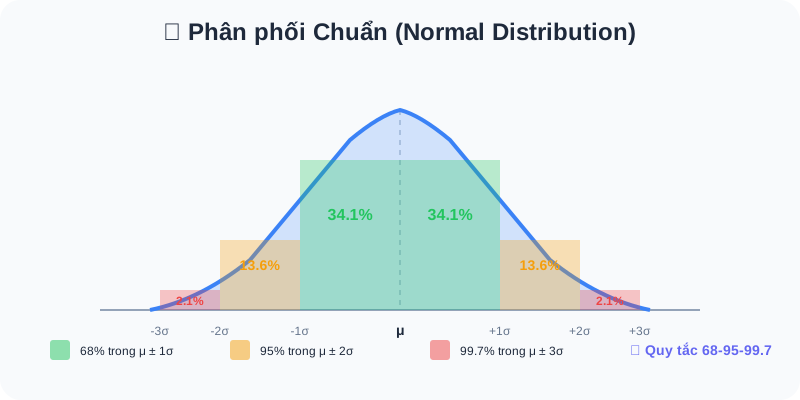
2.1 Công thức PDF
Ký hiệu:
2.2 Tính chất
Tính chất Normal Distribution
2.3 Các tham số
| Tham số | Ảnh hưởng |
|---|---|
| μ (mean) | Vị trí trung tâm |
| σ (std) | Độ rộng/phân tán |
2.4 Code minh họa
1import numpy as np2import matplotlib.pyplot as plt3from scipy import stats45# Các normal distribution khác nhau6fig, axes = plt.subplots(1, 2, figsize=(14, 5))78# Thay đổi μ9x = np.linspace(-10, 15, 1000)10for mu in [0, 3, 6]:11 axes[0].plot(x, stats.norm.pdf(x, mu, 2), label=f'μ={mu}, σ=2')12axes[0].set_title('Effect of μ (mean)')13axes[0].legend()14axes[0].grid(True)1516# Thay đổi σ17for sigma in [1, 2, 3]:18 axes[1].plot(x, stats.norm.pdf(x, 0, sigma), label=f'μ=0, σ={sigma}')19axes[1].set_title('Effect of σ (std)')20axes[1].legend()21axes[1].grid(True)2223plt.tight_layout()24plt.show()🎯 Standard Normal Distribution
3.1 Định nghĩa
Standard Normal có và :
3.2 Standardization (Chuẩn hóa)
Chuyển đổi bất kỳ Normal nào thành Standard Normal:
3.3 Sử dụng Z-table
Z-table cho biết = CDF(z)
| Z | P(Z ≤ z) |
|---|---|
| -2 | 0.0228 |
| -1 | 0.1587 |
| 0 | 0.5000 |
| 1 | 0.8413 |
| 2 | 0.9772 |
3.4 Ví dụ tính toán
Điểm IQ ~ N(100, 15²). P(IQ > 130)?
Bước 1: Chuẩn hóa
Bước 2: Tra bảng
→ Khoảng 2.28% người có IQ > 130
3.5 Code Python
1from scipy import stats23# IQ ~ N(100, 15)4mu, sigma = 100, 155normal = stats.norm(mu, sigma)67# P(IQ > 130)8P_greater_130 = 1 - normal.cdf(130)9print(f"P(IQ > 130) = {P_greater_130:.4f}")1011# P(85 < IQ < 115)12P_between = normal.cdf(115) - normal.cdf(85)13print(f"P(85 < IQ < 115) = {P_between:.4f}")1415# Percentile: IQ của top 5%?16iq_top5 = normal.ppf(0.95)17print(f"Top 5% IQ: {iq_top5:.1f}")1819# Sử dụng Standard Normal20Z = (130 - mu) / sigma21P_z = 1 - stats.norm.cdf(Z)22print(f"Using Z-score: P(Z > {Z}) = {P_z:.4f}")3.6 Tính xác suất các khoảng
1from scipy import stats23norm = stats.norm(0, 1) # Standard Normal45# P(Z < 1.5)6print(f"P(Z < 1.5) = {norm.cdf(1.5):.4f}")78# P(Z > -1)9print(f"P(Z > -1) = {1 - norm.cdf(-1):.4f}")1011# P(-1 < Z < 1)12print(f"P(-1 < Z < 1) = {norm.cdf(1) - norm.cdf(-1):.4f}")1314# Tìm z cho P(Z < z) = 0.9515z_95 = norm.ppf(0.95)16print(f"z for P(Z < z) = 0.95: {z_95:.4f}")Checkpoint
IQ ~ N(100, 15²). P(IQ > 130) = ? Z = (130-100)/15 = 2 → P ≈ 2.28%
🔔 Empirical Rule (68-95-99.7)
4.1 Quy tắc
| Khoảng | % dữ liệu |
|---|---|
| μ ± 1σ | 68.27% |
| μ ± 2σ | 95.45% |
| μ ± 3σ | 99.73% |
4.2 Code minh họa
1from scipy import stats2import numpy as np34norm = stats.norm(0, 1)56# Verify Empirical Rule7print("=== Empirical Rule ===")8print(f"P(-1 < Z < 1) = {norm.cdf(1) - norm.cdf(-1):.4f}") # ~0.68279print(f"P(-2 < Z < 2) = {norm.cdf(2) - norm.cdf(-2):.4f}") # ~0.954510print(f"P(-3 < Z < 3) = {norm.cdf(3) - norm.cdf(-3):.4f}") # ~0.9973⭐ Central Limit Theorem (CLT)
5.1 Phát biểu
Nếu lấy mẫu ngẫu nhiên kích thước n từ một tổng thể bất kỳ có mean μ và std σ, khi n đủ lớn (thường n ≥ 30), phân phối của sample mean sẽ xấp xỉ Normal:
5.2 Standard Error
SE = Standard Deviation của sample mean
5.3 Ý nghĩa
Central Limit Theorem
5.4 Code minh họa CLT
1import numpy as np2import matplotlib.pyplot as plt3from scipy import stats45# Tổng thể không phải Normal (Uniform distribution)6population = np.random.uniform(0, 10, 100000)78fig, axes = plt.subplots(2, 3, figsize=(15, 8))910# Population distribution11axes[0, 0].hist(population, bins=50, density=True, alpha=0.7)12axes[0, 0].set_title('Population (Uniform)')1314# Sample means với n khác nhau15sample_sizes = [5, 10, 30, 50, 100]1617for i, n in enumerate(sample_sizes):18 sample_means = [np.mean(np.random.choice(population, n)) for _ in range(1000)]19 20 row, col = (i+1) // 3, (i+1) % 321 axes[row, col].hist(sample_means, bins=30, density=True, alpha=0.7)22 axes[row, col].set_title(f'Sample Means (n={n})')23 24 # Overlay theoretical normal25 x = np.linspace(min(sample_means), max(sample_means), 100)26 theoretical = stats.norm.pdf(x, 5, 10/np.sqrt(12)/np.sqrt(n))27 axes[row, col].plot(x, theoretical, 'r-', linewidth=2)2829plt.tight_layout()30plt.show()3132# Verify CLT33print("=== CLT Verification ===")34print(f"Population mean: {np.mean(population):.4f}")35print(f"Population std: {np.std(population):.4f}")3637for n in [30, 100]:38 sample_means = [np.mean(np.random.choice(population, n)) for _ in range(10000)]39 print(f"\nn = {n}:")40 print(f"Mean of sample means: {np.mean(sample_means):.4f}")41 print(f"SE (theoretical): {np.std(population)/np.sqrt(n):.4f}")42 print(f"SE (empirical): {np.std(sample_means):.4f}")5.5 Ứng dụng CLT
Ví dụ: Thời gian chờ trung bình ~ N(10 phút, 4²). Với mẫu 64 khách hàng:
SE = = 0.5
1mu, sigma = 10, 42n = 643SE = sigma / np.sqrt(n)45# P(sample mean > 11 phút)?6P = 1 - stats.norm.cdf(11, mu, SE)7print(f"P(X̄ > 11) = {P:.4f}")Checkpoint
CLT là nền tảng của Confidence Intervals và Hypothesis Testing. Bạn hiểu tại sao chưa?
⏰ Exponential Distribution
6.1 Định nghĩa
Mô hình hóa thời gian chờ giữa các sự kiện trong Poisson process.
6.2 Tính chất
| Thống kê | Công thức |
|---|---|
| E(X) | 1/λ |
| Var(X) | 1/λ² |
| CDF |
6.3 Memoryless Property
Xác suất chờ thêm t không phụ thuộc vào đã chờ s.
6.4 Code Python
1from scipy import stats2import numpy as np3import matplotlib.pyplot as plt45# λ = 0.5 (trung bình 2 phút/sự kiện)6lam = 0.57exp = stats.expon(scale=1/lam) # scipy dùng scale = 1/λ89# P(X < 3)10print(f"P(X < 3) = {exp.cdf(3):.4f}")1112# P(X > 5)13print(f"P(X > 5) = {1 - exp.cdf(5):.4f}")1415# E(X) và Var(X)16print(f"E(X) = {exp.mean():.4f}") # 217print(f"Var(X) = {exp.var():.4f}") # 41819# Visualization20x = np.linspace(0, 10, 1000)21plt.figure(figsize=(10, 5))22plt.plot(x, exp.pdf(x), label='PDF')23plt.fill_between(x, exp.pdf(x), where=(x < 3), alpha=0.3, label='P(X < 3)')24plt.xlabel('Time')25plt.ylabel('Density')26plt.title(f'Exponential Distribution (λ={lam})')27plt.legend()28plt.grid(True)29plt.show()🔍 Kiểm tra tính Normal
7.1 Visual Methods
1import numpy as np2import matplotlib.pyplot as plt3from scipy import stats45# Generate data6np.random.seed(42)7normal_data = np.random.normal(50, 10, 1000)8skewed_data = np.random.exponential(10, 1000)910fig, axes = plt.subplots(2, 2, figsize=(12, 10))1112# Histogram + Normal curve13axes[0, 0].hist(normal_data, bins=30, density=True, alpha=0.7)14x = np.linspace(10, 90, 100)15axes[0, 0].plot(x, stats.norm.pdf(x, 50, 10), 'r-', linewidth=2)16axes[0, 0].set_title('Normal Data: Histogram')1718axes[0, 1].hist(skewed_data, bins=30, density=True, alpha=0.7)19axes[0, 1].set_title('Skewed Data: Histogram')2021# Q-Q Plot22stats.probplot(normal_data, dist="norm", plot=axes[1, 0])23axes[1, 0].set_title('Normal Data: Q-Q Plot')2425stats.probplot(skewed_data, dist="norm", plot=axes[1, 1])26axes[1, 1].set_title('Skewed Data: Q-Q Plot')2728plt.tight_layout()29plt.show()7.2 Statistical Tests
1from scipy import stats23# Shapiro-Wilk Test (n < 5000)4stat, p_value = stats.shapiro(normal_data[:500])5print(f"Shapiro-Wilk Test:")6print(f"Statistic: {stat:.4f}, p-value: {p_value:.4f}")7print(f"Normal: {p_value > 0.05}")89# D'Agostino's K² Test10stat, p_value = stats.normaltest(normal_data)11print(f"\nD'Agostino's K² Test:")12print(f"Statistic: {stat:.4f}, p-value: {p_value:.4f}")🧩 Bài tập thực hành
Bài tập 1: Standard Normal
- P(Z < 1.64)?
- P(Z > -0.5)?
- P(-1.96 < Z < 1.96)?
- Tìm z sao cho P(Z > z) = 0.10
Bài tập 2: Normal Distribution
Chiều cao nam sinh viên ~ N(170cm, 6²):
- P(cao hơn 180cm)?
- P(cao từ 165-175cm)?
- Top 10% cao bao nhiêu cm?
Bài tập 3: CLT
Thời gian xử lý đơn hàng: μ = 15 phút, σ = 5 phút. Với mẫu 100 đơn:
- SE = ?
- P(thời gian trung bình > 16 phút)?
📝 Tổng Kết
| Phân phối | PDF/Tính chất | E(X) | Var(X) |
|---|---|---|---|
| Normal | Bell curve, symmetric | μ | σ² |
| Standard Normal | N(0,1) | 0 | 1 |
| Exponential | Memoryless | 1/λ | 1/λ² |
Câu hỏi tự kiểm tra
- Tại sao phân phối Normal được coi là quan trọng nhất trong thống kê?
- Định lý Giới hạn Trung tâm (CLT) phát biểu điều gì và có ý nghĩa thực tế gì?
- Standard Error (SE) khác gì với Standard Deviation (SD)?
- Phân phối Exponential có tính chất "memoryless" — điều này có nghĩa gì?
- Normal là phân phối quan trọng nhất trong thống kê
- Z-score chuẩn hóa về Standard Normal
- CLT: sample mean → Normal khi n lớn
- SE = σ/√n giảm khi n tăng
- Exponential cho thời gian chờ
🎉 Tuyệt vời! Bạn đã hoàn thành bài học Phân phối liên tục!
Tiếp theo: Chúng ta sẽ học về Lấy mẫu (Sampling) — cách chọn mẫu đại diện và ước lượng chính xác.